Searched For result

Social Media Trends 2025: Core Insights

2025 marks a turning point for Social Media, where creativity, agility, and technology are reshaping how brands connect with their audiences. No longer is success measured by simply keeping pace with fleeting trends; today’s top performing organizations are rewriting the rules entirely. With social listening at the heart of strategy, AI as an essential thought partner, and bold experimentation driving engagement, businesses are finding new ways to spark conversations, build trust, and deliver real business impact.

This article explores the most significant social media trends defining 2025 and how brands can embrace them to stay relevant, relatable, and results-driven.

Creative Disruption: Brands Break Consistency Rules

  • Brands are abandoning rigid brand consistency to push creativity.
  • 81% to 100% of content from “Creative Risk Takers” focuses on entertaining, educating, or informing not promoting.
  • Social is now a playground for bold, distinct personalities, even ones that differ from the brand’s traditional image.
  • Example: Hever Castle & RSPB show vastly different social content vs. their websites.Article content

Takeaway: Brands willing to experiment creatively on social see stronger audience connections and business impact.

Outbound Engagement: Brands Jump into Creator Conversations

  • Brands increasingly comment on creators’ posts to gain visibility.
  • Mid-length (10–99 character) comments within 24 hours of posting perform best.
  • Nano and micro-influencers (1k–50k followers) offer high response rates.
  • Example: Mastercard uses outbound comments to align with their “Priceless” campaign moments.

Takeaway: Smart, timely, authentic comments in relevant creator spaces can expand audience reach significantly.

Social Performance: Listening Drives Measurable ROI

  • Social listening is the key to proving ROI.
  • 62% of marketers use social listening, reporting higher confidence in ROI across all major platforms.
  • Social listening identifies: Market gaps, Competitor weaknesses, Product opportunities, Crisis moments
  • Example: Grand Canyon University used listening to improve campus dining and enrollment marketing.
Takeaway: Social Listening fuels data-driven strategies that connect social efforts to real business results.
 

Micro-Virality: The Shift from Broad Trends to Niche Wins

  • “Going viral” is now seen as overhyped; brands chase tailored, community level virality.
  • Social listening helps brands: Analyze trend lifespan, Assess alignment with brand goals, Understand audience sentiment
  • Example: Georgia State University uses listening to create student led trends that naturally amplify brand awareness.

Takeaway: Small scale, community relevant trends outperform mass “trendjacking.”

AI Content Creation: From Experiment to Essential

  • Generative AI is fully integrated into content workflows.
  • 83% of marketers say AI helps produce more content efficiently.
  • AI assists with: Text & image creation, Ideation, Editing & repurposing content
  • Even heavily regulated industries like finance & healthcare now rely on AI.
  • Example: Druva uses AI to help a one-person social team stay agile.

 Takeaway: AI isn’t optional it’s essential to meet content demands and stay competitive.

AI Strategy: AI Becomes a Thought Partner

  • AI is no longer limited to execution strategists use it for: Brainstorming, Campaign planning, Competitor analysis
  • Social teams updating strategy frequently (weekly/monthly) use AI the most.
  • Example: Hootsuite’s leadership uses AI to summarize meetings and draft briefs.

Takeaway: AI boosts strategic agility, helping teams adapt faster and uncover new opportunities.

Practical Recommendations

✔ Ditch strict brand consistency in favor of platform native creativity.

✔ Train AI tools with your style guide for authentic content output.

✔ Engage creators’ comment sections with relevance, value, and timing.

✔ Use social listening as your central tool for trends, competitor intel, and crisis management.

✔ Aim for “Micro Virality” tailored to your niche audience, not broad trend chasing.

✔ Make AI fluency a must have skill for your social media hires.

✔ Blend AI with human oversight; AI for speed, humans for nuance.

Reference: Hootsuite Social Media Report 2025

Efficient AI-Powered Tools for Digital Marketing: How to Stay Ahead in 2024

As businesses strive to stay competitive in an increasingly digital world, AI-powered tools for digital marketing have become indispensable. With the rise of artificial intelligence (AI), marketers can now automate repetitive tasks, make data-driven decisions, and create highly personalized customer experiences at scale.

In 2024, the use of AI in digital marketing will be essential for companies looking to optimize their strategies and stay ahead of their competitors. This blog explores how the best AI tools for digital marketing are revolutionizing content creation, SEO, social media marketing, paid advertising, and data analytics. We’ll also discuss how to use AI-powered tools for digital marketing to improve efficiency, boost engagement, and drive better results.

Key Takeaway: Leveraging AI-powered tools for digital marketing allows businesses to improve efficiency, enhance personalization, and drive better results across all marketing channels, positioning them for success in 2024 and beyond.

Don't have time to read?
Download now as a PDF!

Table of Contents

AI in Digital Marketing: Revolutionizing Content Creation

Content is the backbone of digital marketing, but producing high-quality content consistently can be a challenge for many businesses. Enter AI-powered content creation tools, which are transforming the way marketers develop and distribute content. Platforms like Jasper AI, Copy.ai, and Writesonic use natural language processing (NLP) to generate articles, blog posts, product descriptions, and social media updates quickly and efficiently.

By using AI tools for marketing, businesses can create content that is not only engaging but also optimized for search engines, increasing their chances of ranking higher in search results. AI tools analyze vast amounts of data, such as keyword trends and audience preferences, to suggest content ideas that resonate with your target audience.

Key Benefits of AI-Powered Content Creation

  • Faster Content Production: AI tools can produce well-researched, SEO-optimized content in minutes, allowing marketers to focus on strategy rather than execution.
  • SEO-Driven Suggestions: AI-powered content tools ensure that your articles are optimized for keywords and structured in a way that appeals to both search engines and readers.
  • Personalization: AI can analyze user data to create personalized content, ensuring that the right message reaches the right audience at the right time.

Pro Tip: Use AI-generated outlines and topic suggestions to enhance your content planning process. With the help of AI-powered tools, you can craft detailed and engaging content that meets the needs of your audience while boosting SEO performance.

AI-Powered SEO: Optimize Your Website for Higher Rankings

SEO (Search Engine Optimization) is critical for driving organic traffic to your website, and AI is making the process more efficient and effective. Traditional SEO methods often involve time-consuming tasks such as keyword research, content optimization, and backlink analysis. However, AI tools for SEO like Surfer SEO, MarketMuse, and SEMRush have transformed these tasks by using AI to analyze top-performing content and suggest ways to improve your rankings.

AI-powered SEO tools help marketers optimize their content for specific search queries, ensuring it ranks higher in search engine results pages (SERPs). These tools also identify content gaps, provide real-time recommendations for keyword usage, and suggest improvements to content structure and readability.

How AI Tools for SEO Can Help

  • Advanced Keyword Research: AI-powered SEO tools analyze search trends and suggest high-impact keywords that can improve your search rankings.
  • Content Gap Analysis: These tools identify content gaps by comparing your site to competitors, helping you create content that fills those gaps.
  • Automated On-Page Optimization: AI can help optimize meta tags, headlines, and other on-page elements to ensure they align with the latest SEO best practices.

Pro Tip: Regularly update your content with AI-driven recommendations to maintain high rankings in search engines. AI-powered SEO tools can help you stay ahead of algorithm changes and competitive content trends.

AI Tools for Social Media Marketing: Automate and Enhance Your Campaigns

Social media marketing is a fast-paced and competitive landscape, and AI-powered tools can give marketers the edge they need to succeed. With the help of AI tools like Hootsuite Insights, Lately AI, and Buffer, businesses can automate content scheduling, analyze audience behavior, and optimize their social media strategy for maximum engagement.

These AI-powered tools for social media marketing also provide real-time insights into user interactions, helping marketers understand which posts are resonating with their audience. AI tools can recommend the best times to post, identify trending topics, and even suggest content formats that are more likely to drive engagement.

Advantages of AI in Social Media Marketing

  • Content Scheduling and Automation: AI tools can schedule posts across multiple platforms at optimal times, ensuring consistent engagement with your audience.
  • Audience Insights: AI-powered social media tools track audience behavior and preferences, enabling marketers to tailor their content to what resonates most with their followers.
  • Sentiment Analysis: AI tools can analyze social media sentiment, helping brands understand how their audience feels about their products or campaigns.

Pro Tip: Use AI-powered social media tools to monitor your competitors’ performance, identify successful strategies, and incorporate them into your campaigns for a competitive advantage.

AI in Paid Advertising: Smarter Campaigns, Better ROI

Paid advertising is another area where AI has made a significant impact. In 2024, AI-driven ad platforms like Google Ads Smart Bidding and Facebook Ads AI will be instrumental in optimizing ad campaigns for better results. These platforms use machine learning algorithms to analyze user behavior, predict which audiences are most likely to convert, and adjust bids in real time to maximize return on investment (ROI).

With AI in paid advertising, businesses can create highly targeted ads that reach the right audience at the right time. AI tools can also generate predictive models to forecast which ad creatives will perform best, allowing marketers to optimize their ads before they go live.

Benefits of AI-Powered Paid Advertising

  • Dynamic Bidding: AI algorithms automatically adjust bids based on real-time data, ensuring you get the best possible ROI for your ad spend.
  • Targeted Campaigns: AI tools analyze audience behavior and intent, helping you target ads to users who are most likely to engage or convert.
  • Creative Optimization: AI can predict which ad creatives will resonate most with your audience, allowing you to make data-driven decisions about your ad copy, visuals, and messaging.

Pro Tip: Leverage AI-powered tools to run A/B tests on your ad creatives and landing pages. These tests can help you determine which elements are driving conversions and which need improvement.

AI-Driven Analytics: Turning Data Into Actionable Insights

Data is at the core of digital marketing, and AI-powered analytics tools are helping marketers extract valuable insights from vast amounts of data. Platforms like Google Analytics 4, HubSpot, and Tableau are using AI to provide real-time insights into customer behavior, campaign performance, and ROI. These tools help marketers understand their audience, track key performance indicators (KPIs), and make data-driven decisions.

AI-driven analytics tools go beyond traditional reporting by using machine learning to forecast trends, identify opportunities for growth, and suggest actionable strategies for optimization. Marketers can use these insights to improve everything from website design to marketing campaigns.

Why AI-Driven Analytics Matter

  • Predictive Analytics: AI tools use historical data to predict future trends and recommend the best actions for your marketing campaigns.
  • Real-Time Insights: AI-powered analytics platforms provide real-time data on user behavior and campaign performance, allowing marketers to make quick adjustments as needed.
  • Actionable Recommendations: AI tools don’t just present data—they provide actionable insights and recommendations to help you optimize your marketing strategy.

Pro Tip: Use AI analytics tools to track customer behavior across multiple touchpoints, including your website, social media channels, and email campaigns. This will give you a comprehensive view of how your audience interacts with your brand and help you identify opportunities for improvement.

AI for Customer Experience: Enhancing Personalization and Engagement

Personalized marketing is no longer optional—it’s a necessity for engaging modern consumers. AI-powered tools enable marketers to deliver highly personalized experiences at scale. Tools like Dynamic Yield, Segment, and Optimizely use AI to analyze customer data and create personalized marketing campaigns that drive engagement and conversions.

AI can segment audiences based on behavior, preferences, and purchase history, allowing businesses to deliver tailored messages that resonate with each customer. This level of personalization helps build stronger relationships with customers and improves overall marketing effectiveness.

How AI Enhances Customer Experience

  • Behavioral Segmentation: AI tools can segment your audience based on their behavior and preferences, allowing you to deliver highly personalized experiences.
  • Real-Time Personalization: AI-powered platforms can adjust content and messaging in real time based on how users interact with your website or app.
  • Automated Customer Support: AI-driven chatbots can provide instant, personalized customer support, improving user satisfaction and reducing response times.

Pro Tip: Incorporate AI-driven personalization into your email marketing campaigns. Send targeted emails based on user preferences and behaviors to increase open rates, click-through rates, and conversions.

Stay Ahead with AI-Powered Tools for Digital Marketing in 2024

In 2024, the digital marketing landscape will continue to be shaped by AI-powered tools. From content creation and SEO to social media marketing, paid ads, and analytics, AI tools for digital marketing are helping businesses streamline operations, make data-driven decisions, and deliver personalized experiences to their customers.

By integrating these best AI tools for digital marketing into your strategy, you’ll be able to automate repetitive tasks, optimize your campaigns, and stay ahead of the competition in an increasingly crowded digital space.

Power of Social Listening & Social Monitoring

Unlock the potential of social listening & social monitoring to gain valuable insights into your audience, enhance brand loyalty, and stay ahead of the competition. In today’s digital age, social media is a goldmine of data, but making sense of it all can be overwhelming. 

Social listening & social monitoring is the key to actively interpreting online conversations about your brand, providing the transformative insights needed to elevate your social media strategy. Curious to discover how social listening can empower you? Keep reading to learn more.

Table of Contents

Unveiling the Power of Social Listening

In today’s digital age, brands are inundated with online interactions such as likes, comments, and shares. However, leveraging the power of social listening enables businesses to unearth the deeper motivations behind these interactions. Social listening goes beyond mere brand mention monitoring, offering a wealth of insights to revolutionize your social media strategy. Here’s why social listening should be your secret weapon: 

Uncover Brand Sentiment: Move past superficial follower counts and delve into sentiment analysis. Social listening tools enable you to gauge the overall perception of your brand online – is it positive, negative, or neutral? This allows for prompt issue resolution, the ability to leverage positive feedback, and the refinement of your brand’s image.

Identify Brand Advocates: Utilize social listening to identify your strongest advocates – those loyal customers who actively promote your products or services online. Engaging with these brand champions can foster stronger relationships and amplify your brand’s message. 

Gain Competitive Insights: Keep a pulse on the competition through social listening. This approach lets you monitor public sentiment surrounding competitors, uncover their strengths and weaknesses, and potentially identify emerging industry trends. Armed with this knowledge, you can stay ahead of the curve and adjust your marketing strategies accordingly. 

Discover Hidden Gems: Social listening isn’t limited to monitoring existing conversations; it can also unveil new topics and trends within your niche. By understanding genuine audience interests, you can pinpoint valuable content creation opportunities and tailor your product development to meet evolving customer needs.

In essence, social listening provides a potent window into the online world, unveiling critical insights to transform your social media strategy. Are you primed to listen beyond the noise and unlock the true power of social media?

From Awareness to Action: Mastering Social Monitoring

Now that social listening has allowed you to tap into the wealth of information surrounding your brand online, it’s time to translate this awareness into actionable insights. Enter social monitoring – the process of actively tracking brand mentions, keywords, and industry conversations across various social media platforms. Here’s how to turn that awareness into actionable insights: 

Cast Your Net Wide: Expand your reach across platforms like Facebook, Twitter, and Instagram to gain a comprehensive view of online conversations. Utilize tools to track specific keywords and brand mentions, ensuring you stay informed across all relevant platforms. 

Essential Free Tools: If you’re working within a budget, there are several free social monitoring tools available to kick-start your efforts. Google Alerts is ideal for tracking brand mentions across the web, while Sprout Social’s free plan offers basic monitoring features for a limited number of social profiles. These tools provide a solid foundation for venturing into social monitoring. 

Paid Powerhouses: As your needs evolve, consider investing in paid social monitoring tools such as Brandwatch or Mention. These platforms offer a broader spectrum of features, including advanced analytics, competitor tracking, and sentiment analysis. They provide deeper insights, enabling you to monitor a wider range of online conversations and gain a more comprehensive understanding of your brand’s online presence. 

By incorporating social monitoring alongside social listening, you can revolutionize your understanding of your online audience. You’ll be able to effectively address customer inquiries and feedback, respond to negative sentiment in real time, and engage with brand advocates to foster stronger relationships. So, don’t just listen – take action! Social monitoring empowers you to transform valuable insights into tangible results.

Effective Social Listening & Social Monitoring Strategy

By implementing a robust social listening and monitoring strategy, you can power your social media strategy with a profound understanding of your customers and real-time insights. Here’s how to develop your strategy: 

Define Your Goals: Start by setting clear goals for your strategy. Do you aim to enhance customer service by promptly addressing inquiries? Or perhaps you seek to amplify brand awareness by participating in trending discussions? Clearly defining your objectives will serve as a compass for your approach. 

Craft the Listening Plan: Tailor your monitoring strategy to align with your goals. Determine which keywords or hashtags to track and establish a regular cadence for analyzing the data. This approach ensures that you capture information that is most pertinent to your mission. 

Action Time: Social listening and monitoring require active engagement. Act on the insights you gather! Respond to customer feedback, display empathy when addressing negative sentiment, and interact with your brand advocates to cultivate stronger relationships. 

By following these steps, you can elevate your social media strategy from reactive to proactive, leveraging the power of listening and taking decisive action.

Amplify Your Social Media Presence: Tools, Techniques, and the Power of Integration

Now that you’ve assembled your social listening and monitoring dream strategy, it’s time to maximize its potential! Here’s how to leverage your newfound insights and amplify your social media presence: 

Your Social Media Toolkit: Leverage a variety of tools, both free and paid, to enhance your social listening and monitoring efforts. Free Options: Start with tools like Google Alerts for basic brand mention tracking and Sprout Social’s free plan for a glimpse of social monitoring features. These serve as excellent entry points for beginners. Paid Powerhouses: As your requirements grow, explore paid options such as Brandwatch and Mention. These platforms offer advanced capabilities like competitor tracking, detailed analytics, and sentiment analysis, delivering a more comprehensive comprehension of online conversations.

The Power of Visualization: While data is impactful, clear visuals are essential for effectively communicating your findings. Make use of data visualization tools to translate raw data into compelling charts, graphs, and reports. This facilitates better understanding of the insights and aids in taking informed actions.

Integration is Key: Ensure that social listening and monitoring are seamlessly integrated into your broader marketing initiatives. Utilize these insights to shape your social media content strategy, ensuring that the content resonates with your audience. Additionally, harness these insights to optimize your paid advertising campaigns, targeting the right audience with tailored messaging. Ultimately, social listening and monitoring should form a vital component of your overall marketing strategy. 

By employing the right tools, presenting your data effectively, and integrating your insights seamlessly, you can bolster your social media presence and achieve tangible results. So, embody the principles of listening, analysis, and action! Witness your social media strategy ascend to new heights.

Quick Recap: The Power is in Your Hands

Social listening and monitoring have the potential to transform your social media strategy. By actively listening to your audience and acting on the insights you gather, you can: 

  • Gain a deeper understanding of your customers 
  • Enhance customer service and brand reputation
  • Identify and engage with brand advocates 
  • Uncover industry trends and shape your content creation 
  • Stay ahead of the competition 

Steps to kickstart your journey: 

  • Define your social media goals. 
  • Select the right tools for your needs (both free and paid options are available). 
  • Create a listening plan to monitor relevant keywords and hashtags. 
  • Analyze your data and act on the insights you uncover. 

I hope this effort enlightens you about the key benefits of social listening and monitoring; will also inspire you to begin implementing these strategies in your social media management. By taking these steps and exploring the available resources, you can tap into the power of social listening and monitoring, ultimately transforming your social media strategy!

The Ultimate Guide to On Page SEO Techniques with Examples

Are you stuck on page two of the search results, or worse? Do you want to be on Google’s first page of results? SEO enthusiasts, fear not! This comprehensive guide to on page SEO tactics is your one-stop solution for dramatically improving your website’s ranking. With plenty of real-world examples, this article will break down the newest tactics and trends to make optimization simple.

Get ready to dominate the search results, unleash a flood of organic traffic, and surpass your competition. Let’s dive in and unleash the full On page SEO potential of your website!

Demystifying On Page SEO for Ultimate Website Success!

Ever wondered why some websites rank at the top of search results while others don’t? On page SEO is the key to this puzzle. But what exactly is it, and why does it matter to you?

On page SEO refers to the optimization strategies used on your website to improve its search engine ranking. Think of search engines as investigators that analyze webpages to assess their relevance and content. By ensuring that your website’s content, structure, and technical aspects are optimized, you essentially help these investigators understand the purpose of your website. The better they comprehend your site, the more likely they are to rank it for relevant search terms.

Think of it this way: a well-organized and well-maintained store is much easier to navigate and shop in compared to a disorganized one. Similarly, websites that offer a similar user experience are rewarded by search engines with higher search result rankings.

5 Steps to Unlock the Potential of Keyword Research

Are you ready to supercharge your website with the perfect keywords? Let’s dive into the exciting world of keyword research for On Page SEO and find out how you can do it all by yourself. 

Step 1: Kickstart Your Brainstorming Session

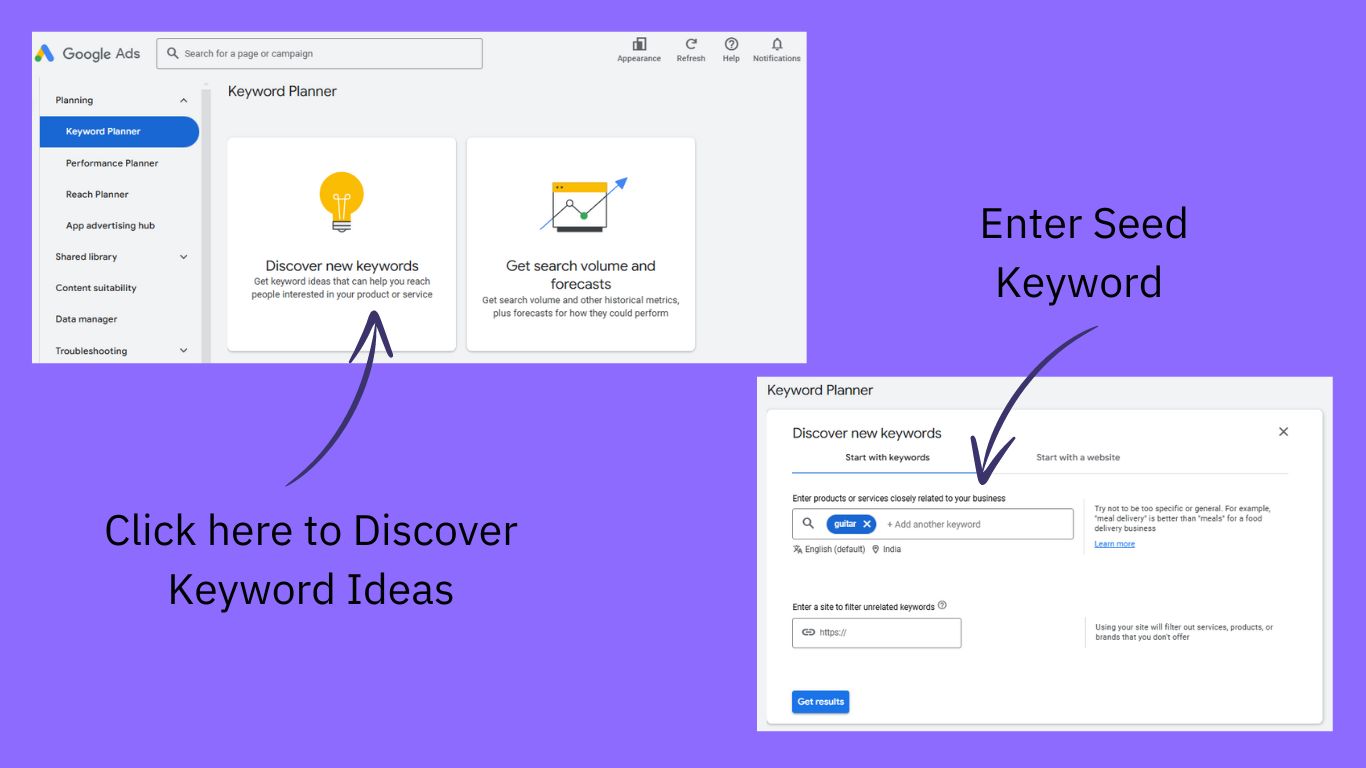
Think of keywords as the foundation of your website’s content. Start by identifying a “seed keyword” that represents your niche. For instance, if you own an online guitar store, your seed keyword could be “guitar”. 

Google Keyword Planner to discover keyword ideas and get search volume of the keywords.

Step 2: Harness the Power of Free Keyword Tools

On Page SEO journey starts with Keyword Research, and for it you must start with the free tools. Get ready to uncover a goldmine of free keyword research tools!

Here are some top picks to get you started: 

  • Google Keyword Planner: This amazing tool from Google lets you explore related keywords and estimate their search volume. Aim for keywords with a search volume above 1000 for your initial targeting. 
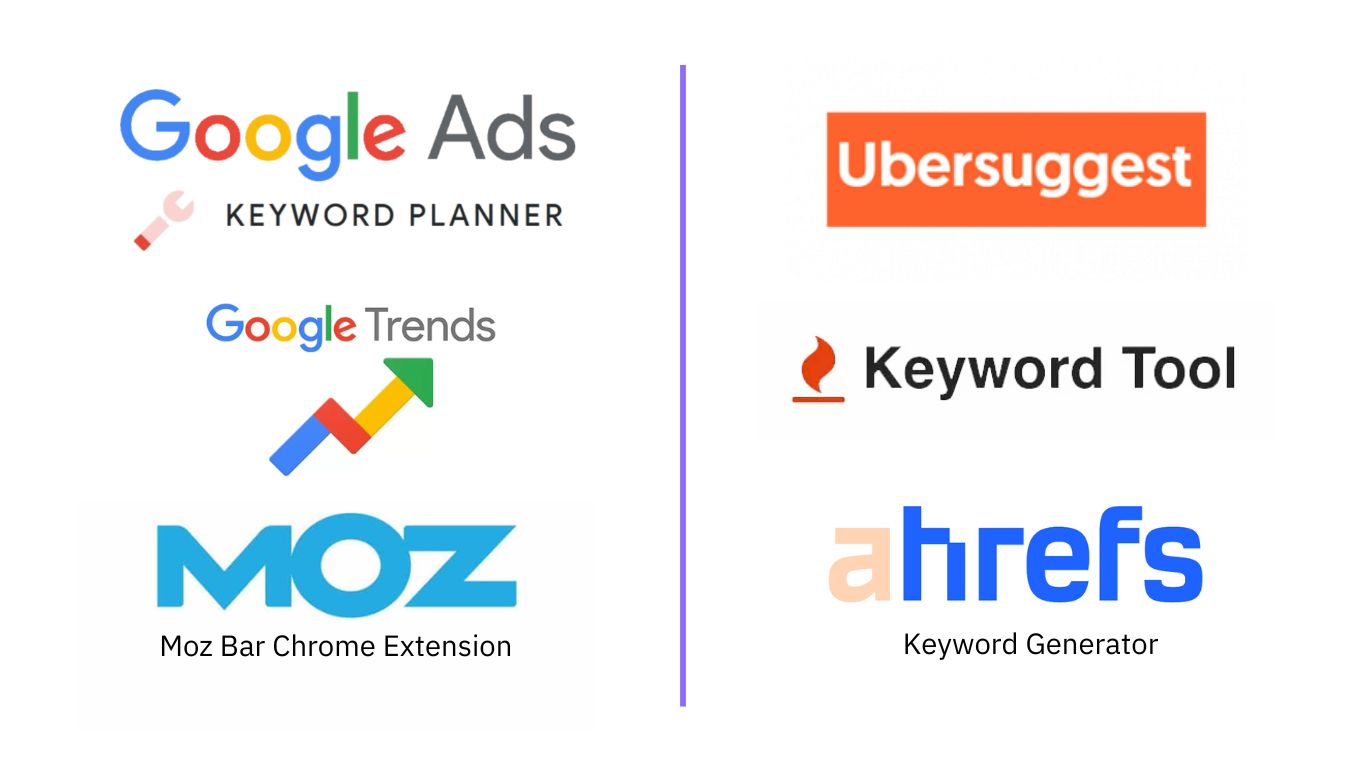
  • Keywordtool.io, Ubersuggest, Ahrefs Keyword Generator: These fantastic free tools provide a plethora of keyword suggestions beyond search volume. Explore them to discover even more relevant terms. 
  • Answer the Public: This clever tool uncovers the questions people are asking about your seed keyword. These long-tail phrases are pure gold for attracting targeted traffic.
SEO Tools - Google Keyword Planner, Google Trends, Moz Bar Chrome Extension, Ubersuggest, Keywordtool.io, Ahrefs keyword generator

Step 3: Discover the Power of Keywords with Google Trends

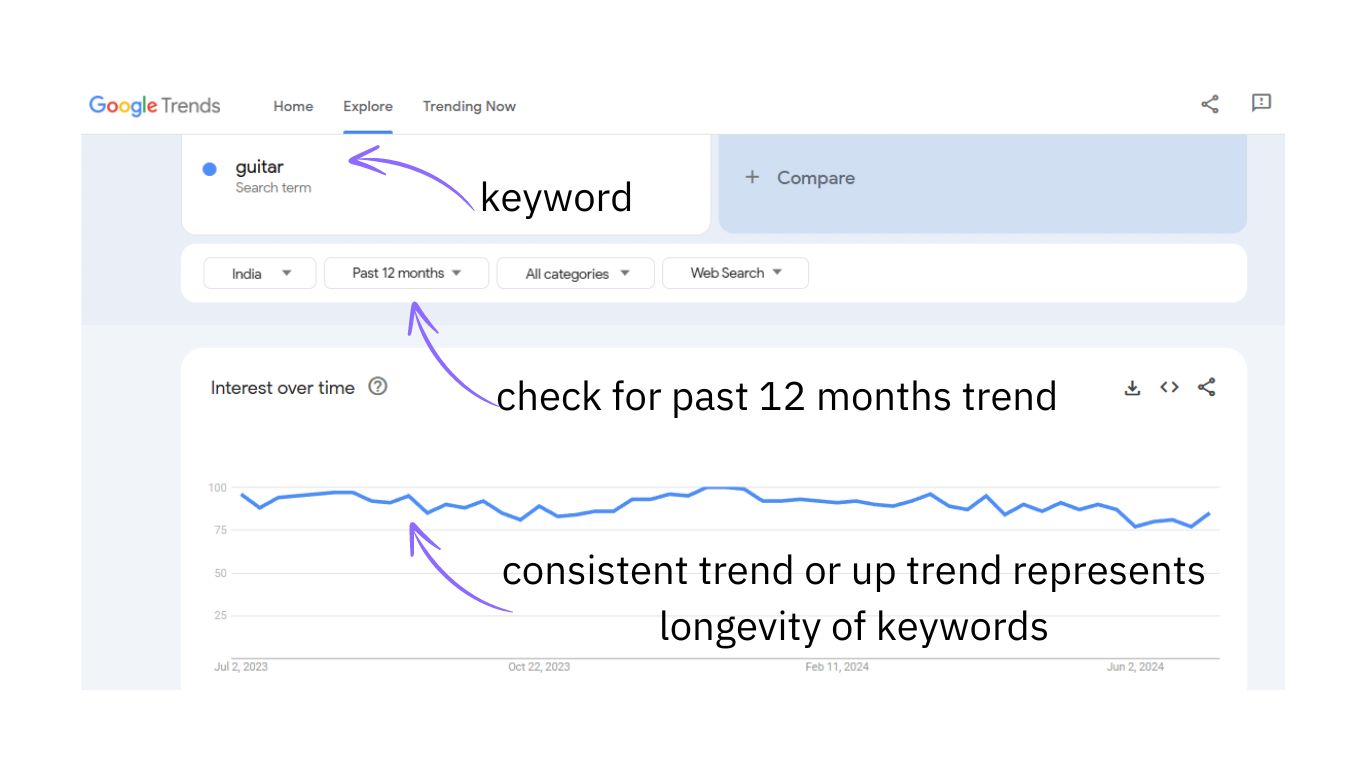
While Not all keywords are created equal! Google Trends offers a fascinating insight into keyword longevity by showcasing search volume trends over the past year. Seek out keywords with a stable or upward trend to guarantee consistent organic traffic in the future. Rate the trend on a scale of 0-10 (0 being a downward trend, and 10 representing a fantastic upward trend). For on page SEO, longevity of keyword is essential for consistent organic traffic.

Google trends is used to analyze the past search trend of keyword n google.

Step 4: Analyse Keyword Difficulty with MOZ Bar Chrome Extension

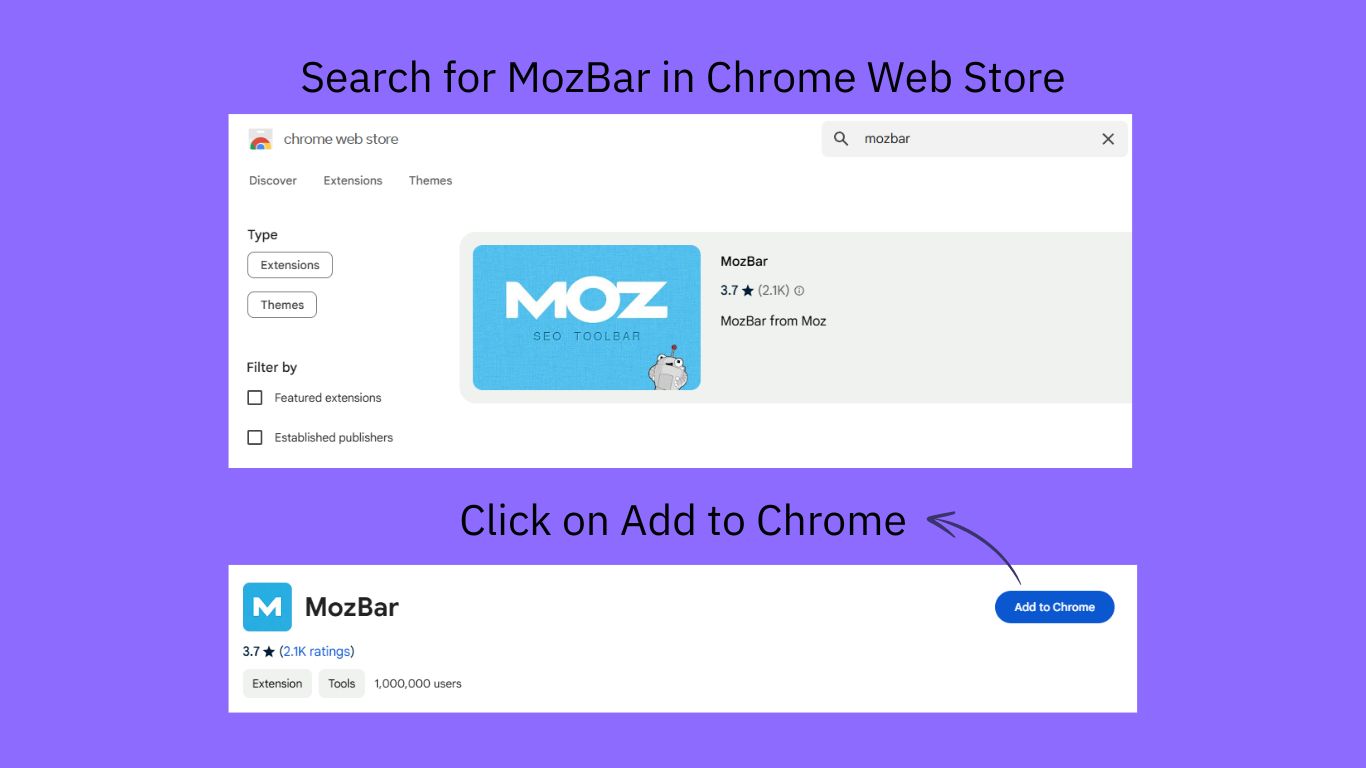
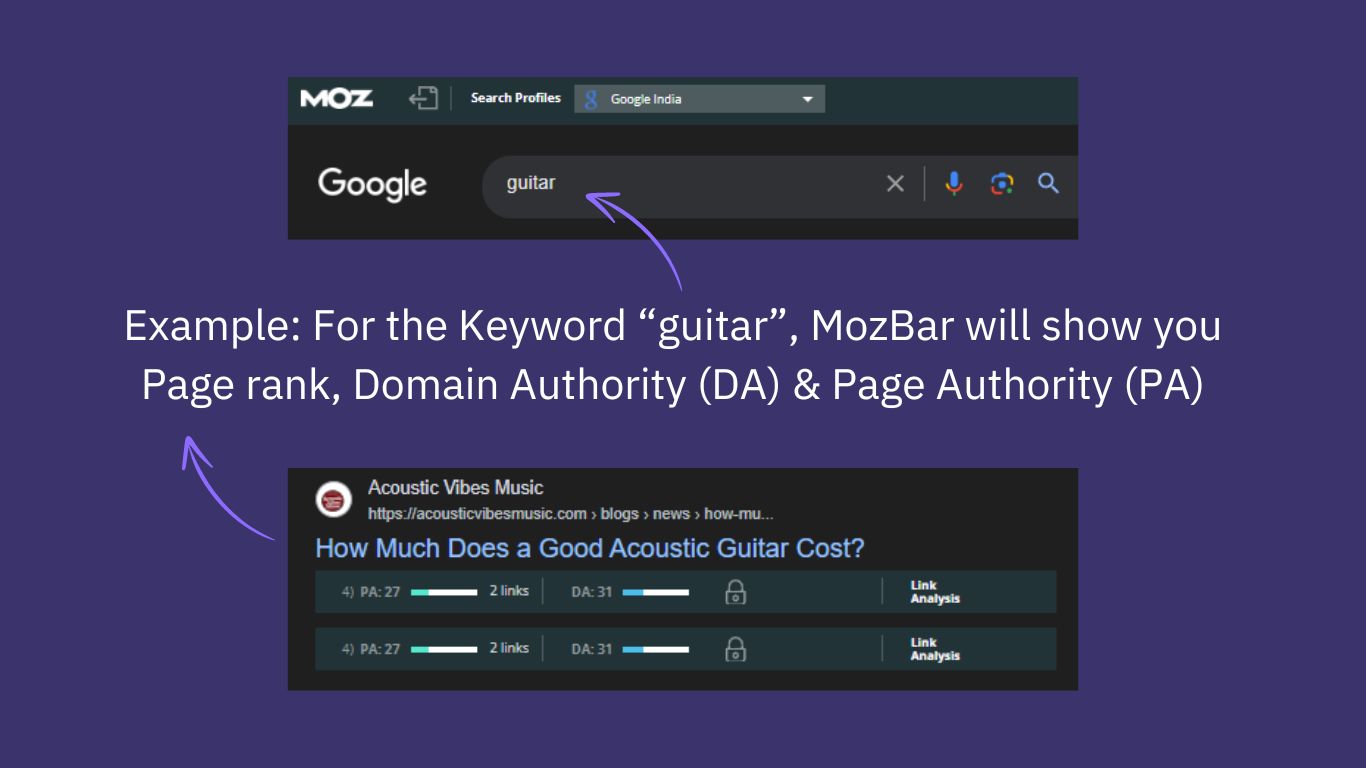
Picture ranking for a keyword as conquering a mountain. Some keywords are like scaling Mount Everest, while others are as gentle as hills. The MOZ Bar Chrome Extension assists in estimating a website’s Domain Authority (DA) and Page Authority (PA) – crucial metrics that indicate the difficulty of ranking for a keyword. Websites with a DA/PA of less than 25 in the top 10 search results suggest a lower difficulty keyword. Rate the difficulty on a scale of 0-10 (0 being extremely high DA/PA – hard to rank, while 10 being extremely low DA/PA – easy to rank). 

 with difficult keywords, you will find that only 

Adding MOZ Bar Chrome Extension to Chrome Web Browser

Step 5: Embrace Your Champions

Now comes the exciting part – selecting your target keywords! 

Prioritize keywords with: High Search Volume: Target keywords with a minimum of 1000 monthly searches. Positive Trend (Google Trends): Opt for keywords with a stable or increasing search volume trend. Low Difficulty (Moz Bar): Focus on keywords where the top 10 ranking websites have a lower DA/PA.

PRO Tip: Don’t just rely on search volume alone! Consider the intent behind the keyword. For example, are people looking for information (e.g., “how to play guitar”) or ready to buy (e.g., “best acoustic guitar for beginners under 5000”)? Choose keywords that align with your website’s goals.

Crafting Content That Captivates Both Users and Search Engines

When it comes to on-page SEO, content truly reigns supreme! It’s not just about throwing together words; it’s about creating top-notch content that resonates with both search engines and your target audience. Let’s dive into how to strike the perfect balance:

Captivating Content for both Readers and Search Engines

Informative and Engaging: Focus on crafting valuable, informative content that genuinely assists your audience. Answer their questions, solve their problems, and offer fresh insights. Not only does this keep readers engaged, but it also establishes your website as a trusted resource. Search engines favor websites with content that demonstrably satisfies user intent. 

Structured for Success: Readability is crucial. Use clear headings, subheadings, and bullet points to break down your content into easily digestible chunks. This enhances user experience and helps search engines understand your content’s hierarchy and key points. 

Keyword Harmony: Targeted keywords are essential for search engine visibility, but avoid falling into the trap of keyword stuffing. Integrate your keywords naturally throughout your content to ensure they flow seamlessly and enhance readability.

Quality SEO Content Matters

When aiming to boost our website’s visibility, user engagement is key. According to recent insights from Google APIs, user interaction and session time play crucial roles in determining our page’s ranking on search engine results. To ensure a top spot on the SERPs, we must focus on creating high-quality, engaging content. 

To achieve this, we need to curate in-depth blog posts spanning 1500-2000 words. Breaking down the content with strategic headings and subheadings is essential for enhancing readability. Each heading should incorporate the focus keyword and align with the overall structure and title of the blog. Additionally, the content should include a compelling 100-word introduction that sets the stage and a concise conclusion providing key takeaways. 

By implementing these tactics, we can deliver top-notch content that captivates our audience and elevates our ranking on search engine results.

Staying Ahead of the Curve: Recent Trends

The world of SEO is always evolving, and it’s important to keep these key trends in mind:

EAT (Expertise, Authoritativeness, and Trustworthiness): Establish yourself as an expert by showcasing your qualifications, experience, and positive user reviews to significantly boost your content’s authority and ranking potential.

Content Freshness: Regularly update your content with fresh, relevant information to demonstrate your commitment to providing the latest and greatest information, as search engines favor websites that consistently update their content.

Keep up the great work! Your enthusiasm and professionalism will surely shine through in your SEO efforts.

SERP Snippet for High Click-Through Rates

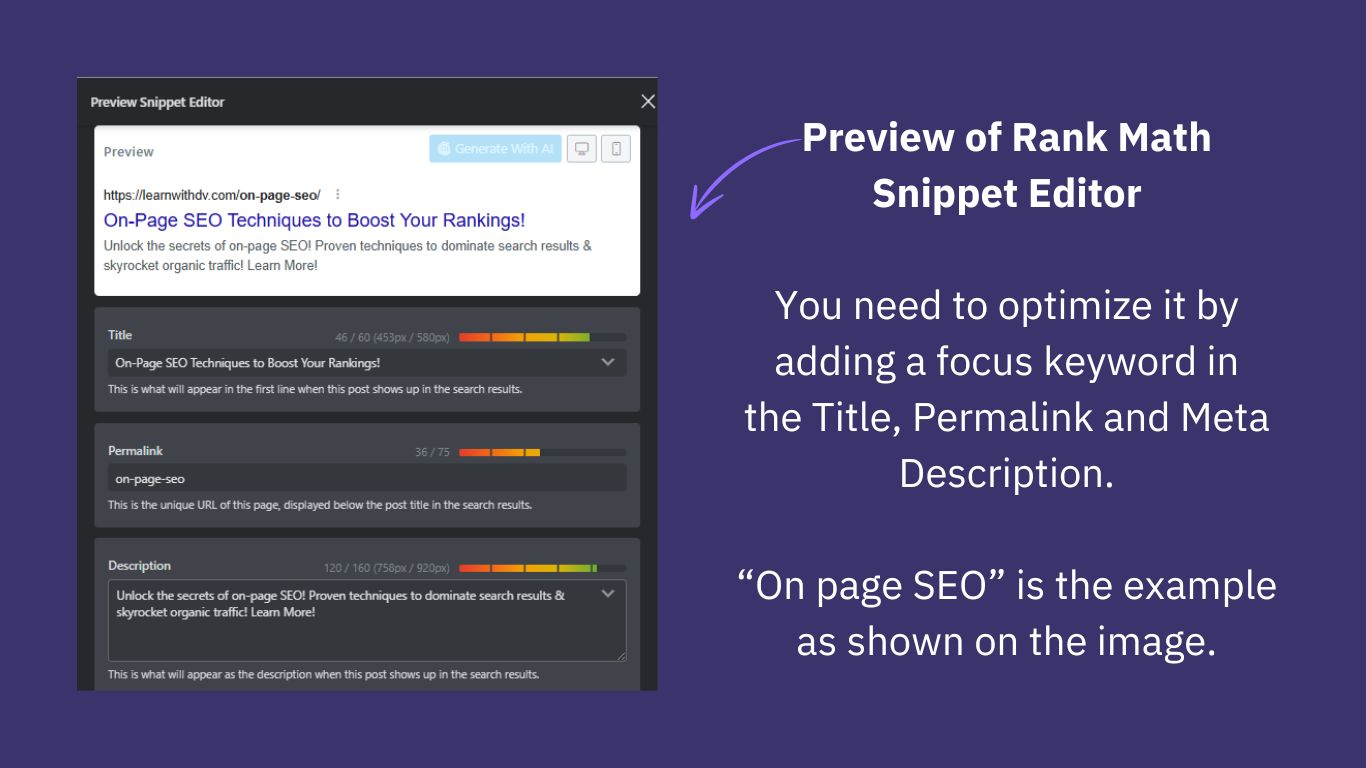
Preview of Rank Math SERP Snippet Editor for on page seo

Picture your website’s content as a beautifully organized store. Just as clear signage in a physical store guides customers to their desired products, titles, headings, and meta descriptions do the same for users and search engines, ensuring they find exactly what they’re looking for.

 1. Title (Under 60 characters): Let’s craft a title that commands attention and boosts your site’s visibility! Keep the primary keyword “On-page SEO Techniques” front and center, highlight the benefit with “Boost Your Rankings!”, and aim for under 60 characters. 

Example Title: On-Page SEO Techniques to Boost Your Rankings! 

2. URL (Clear and Descriptive): Your URL should be a window to what’s inside. Incorporate the main keyword “on-page-seo,” keep it brief and relevant, and ensure it accurately represents your content. Example URL: [invalid URL removed] 

3. Meta Description (Under 160 characters): Time to captivate your audience with a compelling meta description! Start with a bold hook like “Unlock the secrets of on-page SEO!”, briefly explain the value proposition, and include a call to action (CTA) such as “Learn More!” 

Example of Meta Description: Unlock the secrets of on-page SEO! Proven techniques to dominate search results & skyrocket organic traffic! Learn More! 

Remember, clarity and keyword relevance are the keys to unlocking your site’s potential. Crafting clear titles, headings, and meta descriptions not only enhances user experience but also communicates to search engines the value and structure of your content, leading to higher click-through rates (CTR) and improved search engine ranking.

Technical On Page SEO: Elevating Performance

Ensuring technical SEO for your website is essential for seamless search engine crawling and indexing. Just imagine a stunning store in a remote location with no roads leading to it – that’s what a technically flawed website is like for search engines. Technical SEO guarantees that your website is accessible, crawlable, and user-friendly, enabling search engines to effortlessly find, understand, and index your content. 

When it comes to optimizing for speed and mobile, page speed is paramount in today’s fast-paced world. Users expect lightning-fast loading times, so optimizing images, compressing code, and leveraging caching mechanisms is crucial. Additionally, with mobile usage surpassing desktop, having a mobile-friendly website is no longer optional. Responsive design is key to ensuring your website seamlessly adapts to any device, providing an optimal user experience for all visitors.

Implementing strategies such as image optimization, responsive design, and internal linking are essential for building a strong website structure. Internal linking creates a well-organized network of pathways within your website, enhancing user experience and helping search engines understand the hierarchy and flow of your content. 

Recent advancements like schema markup add rich labels to your website’s content, providing search engines with additional context about your content. This can lead to richer search results and significantly improve click-through rates. 

By prioritizing technical on page SEO, you lay the groundwork for a website that search engines can easily access and understand. Coupled with strong content and user experience, this creates a winning formula for long-term SEO success.

Advanced On Page SEO Techniques

Once you’ve nailed down the fundamental principles of on-page SEO, get ready to explore the exciting world of advanced strategies to elevate your website’s optimization to the next level.

Supercharge Your Website with Image Optimization

Images are not just visually appealing; they hold remarkable potential for SEO. Craft descriptive alt text for each image to provide essential information to search engines and visually impaired users. Instead of generic labels like “picture1.jpg,” opt for detailed descriptions like “Woman hiking on a scenic mountain trail.”

Unleash the Power of Backlink Authority

Imagine backlinks as endorsements for your website. When reputable websites link to your content, it establishes trust and relevance with search engines. Generating backlinks requires effort, but it’s worth it. Here are some tactics to consider:

  • Create Compelling Content: Develop informative and engaging content that naturally attracts links from other websites. 
  • Guest Blogging: Contribute guest posts to niche-relevant websites, including a link back to your site within the content. Quality over quantity is the golden rule for backlinks. Focus on earning links from reputable websites in your niche

Track and Improve Your On-Page SEO Performance

On page SEO is an ongoing journey. To ensure continuous progress, utilize website analytics tools to track your performance. Leverage tools like Google Search Console to monitor metrics such as organic traffic, keyword rankings, and user engagement. Use the data to make informed decisions to enhance your SEO strategy.

By analyzing the data, you can pinpoint areas for improvement and take decisive action to enhance your website’s performance.

On Page SEO can reach new heights by monitoring keyword rankings in Google Search Console and optimizing user engagement based on insights from Google Analytics. It’s all about fine-tuning and enhancing your website’s performance for ultimate success.

Search Engine Optimization (SEO) Techniques to Drive Organic Traffic

Table of Contents

What is Search Engine Optimization (SEO)?

Search Engine Optimization (SEO) is the practice of improving your website’s visibility in search engine results pages (SERPs). The higher your website ranks for relevant searches, the more organic traffic you’ll attract. SEO focuses on non-paid traffic, also known as organic traffic. This means people come to your site through search results, rather than clicking on ads or typing in the website address directly.

Ultimately, the goal of search engine optimization is to help attract website visitors who will become customers, clients or an audience that keeps coming back.

How Search Engine Works?

Search engines are tools that find and rank web content matching a user’ search query. Each search engine consists of two main parts:

  • Search index: A digital library of information about web pages.
  • Search algorithm: Computer program(s) that rank matching results from the
    search index.

Search Engines like Google or Bing have trillions of pages in their search indexes. So, before we talk about ranking algorithms, let’s know the mechanisms used to build and maintain a web index. There are four steps:

  • Crawling: Crawling is where a computer bot called a spider (e.g., Googlebot) visits and downloads the discovered pages. It’s important to note that Google doesn’t always crawl pages in the order they discover them. Google queues URLs for crawling based on a few factors, including: PageRank of the URL, How often the URL changes, Whether or not it’s new. This is important because it means that search engines might crawl and index some of your pages before others. If you have a large website, it could take a while for search engines to fully crawl it.
  • URL Discovery: Everything begins with a known list of URLs. Some common techniques that helps Google bots to quickly discover your URLs are Quality Backlinks, Sitemap Submission, URL Inspection & Request Indexing.
    • Backlinks: Google already has an index containing trillions of web pages. If someone adds a link to one of your pages from one of those web pages, they can find it from there.
    • Sitemap: Sitemaps list all of the important pages on your website. If you submit your sitemap to Google, it may help them discover your website faster.
    • URL Submission: URL SUBMISSION: Google also allows submissions of individual URLs via Google Search Console.
  • Processing: Processing is where Google works to understand and extract key information from crawled pages. Nobody outside of Google knows every detail about this process, but the important parts for our understanding are extracting links and storing content for indexing. 
  • Rendering: Google has to render pages to fully process them, which is where Google runs the page’s code to understand how it looks for users.
  • Indexing: Indexing is where processed information from crawled pages is added to a big database called the search index. This is essentially a digital library of trillions of webpages where Google’s search results come from. When you type a query into a search engine, you’re not directly searching the internet for matching results. You’re searching a search engine’s index of web pages. If a web page isn’t in the search index, search engine users won’t find it. That’s why getting your website indexed in major search engines is so important.
on page seo

Benefits of Search Engine Optimization (SEO)

Ranking higher is the most touted benefit of SEO, but rankings are really just a means to an end. Many of the real benefits of SEO are traffic-related.

  • SEO Leads to More Traffic: Because most people tend to click one of the first few search results, ranking higher usually drives more traffic to your website.
  • SEO Leads to Consistent Traffic: Ranking in search engines usually leads to both consistent and passive traffic. That’s rarely the case for mediums like social media and email marketing that often result in traffic spikes that quickly fade to nothing.
  • SEO Leads to ‘Free’ Traffic: Unlike paying for ads, search traffic is ‘free.’ That’s a big deal because ads on search engines can be expensive.

Pillars of Search Engine Optimization (SEO)

On Page SEO

This focuses on optimizing the elements within your website to be easily understood by both search engines and users. It’s like making your website content speak the search engine’s language while ensuring a great user experience. Here are some key on-page SEO practices:

  • Content: Creating high-quality, informative, and relevant content that targets specific keywords.
  • Keywords: Including relevant keywords in your page titles, meta descriptions, headings, and throughout the content.
  • Website Structure: Building a clear and logical website structure with well-organized navigation to make it easy for users and search engines to find what they’re looking for.
  • Internal Linking: Linking to other relevant pages on your website to improve user experience and help search engines understand the relationships between your pages.
  • Image Optimization: Using relevant filenames, alt tags, and proper image sizes to improve website loading speed and searchability.

Off Page SEO

This refers to all the efforts you make outside your website to improve its ranking. It’s essentially building your website’s reputation and authority in the eyes of search engines. Here are some key off-page SEO strategies:

  • Link Building: Getting high-quality websites to link back to your website. Search engines view these links as a sign of trust and credibility.
  • Brand Mentions: Encouraging mentions of your brand name or website on social media, forums, and other online platforms.
  • Social Media Marketing: Actively promoting your content and engaging with your audience on social media platforms.

Technical SEO

This involves ensuring the technical aspects of your website are functioning properly to allow search engines to crawl and index your website effectively. It’s the foundation upon which all other SEO efforts rely. Here are some key technical SEO considerations:

  • Website Speed: Optimizing your website’s loading speed for a fast and smooth user experience.
  • Mobile-friendliness: Ensuring your website is responsive and easily viewable on all devices, especially mobile phones.
  • Website Security: Having a secure website with a valid SSL certificate to protect user data and build trust.
  • Sitemap: Creating and submitting a sitemap to search engines to help them discover and index your website pages efficiently.
  • Robots.txt: Using a robots.txt file to instruct search engines which pages on your website to crawl and index.

Advanced SEO Strategies

Once you’ve grasped the core SEO concepts, you can delve deeper into advanced strategies to further refine your SEO game:

  • Local SEO: If you have a brick-and-mortar presence or cater to a local audience, optimize your website for local searches using local keywords and claiming your Google My Business listing.
  • Voice Search Optimization: With the rise of voice search assistants like Siri and Alexa, consider optimizing your content for conversational language patterns people use in voice searches.
  • Content Strategy Gems:
    • Topic Clusters & Content Hubs: Move beyond single pages and build content clusters around a central theme. Create a hub page that acts as the main resource, then craft pillar content pages that delve deeper into specific subtopics. Link these pillar pages back to the hub page to establish topical authority.
    • Target “Journalist Keywords”: Identify the questions journalists frequently research and answer them comprehensively on your website. This can attract high-quality backlinks and establish you as an industry expert.
    • Uncover “People Also Ask” Keywords: Utilize Google’s “People Also Ask” section to discover long-tail keyword variations searchers use. Create content that directly addresses these questions to capture valuable user intent.
    • Publish Topic + Year Content: Keep your content fresh and relevant by regularly updating and republishing high-performing content with the current year in the title and body. This ensures your content stays optimized for recent search trends.
  • Technical SEO:
    • Dynamic Parameters for Pagination: Ensure search engines properly crawl and index all pages on your website, even those with paginated content. Utilize dynamic parameters to maintain SEO value across paginated URLs.
    • Leverage Unlinked Brand Mentions: Brand mentions, even without backlinks, can influence search engine perception. Use tools to identify unlinked mentions and reach out to those websites to request backlinks.
    • Optimize for Google Discover: Cater to mobile users by optimizing your content for Google Discover, a feed of content displayed on Google Search apps. Use high-quality images and engaging headlines to grab attention in the fast-paced mobile environment.
    • Visual Content Diversification: Break up text-heavy content with various visual elements like infographics, videos, and illustrations. This improves user engagement and caters to different learning styles, potentially extending dwell time.
  • Link Building Techniques:
    • Build Backlinks with Podcasts: Appear as a guest on relevant podcasts in your niche. This exposes you to a new audience and often earns you a backlink from the podcast website.
    • Forge a Content Alliance: Partner with other websites in your industry to create co-branded content or guest blog posts. This strategy allows you to exchange backlinks and reach a wider audience.
    • Maximize SERP Real Estate: When your website appears in search results, strive to occupy as much space as possible. Utilize rich snippets, structured data markup, and optimize your meta descriptions to create a compelling click-through incentive.

SEO Audit - Monitoring & Analysis

This is the ongoing practice of tracking your website’s SEO health using various tools and metrics. You’ll typically monitor factors like:

  • Search Engine Ranking: Track your website’s ranking for target keywords over time to identify trends and areas for improvements
  • Traffic: Monitor website traffic coming from search engines to gauge the effectiveness of your SEO efforts in attracting visitors.
  • User Behavior: Analyze how users interact with your website, such as dwell time, bounce rate, and click-through rates on internal links. This helps understand how well your website caters to user needs.

An SEO audit is a deep dive into your website’s SEO health at a specific point in time. It involves a comprehensive analysis of various aspects, including:

  • On-page SEO: Evaluates factors like keyword usage, content quality, title tag optimization, meta descriptions, and internal linking structure.
  • Off-page SEO: Analyzes your backlink profile, identifying the quantity and quality of backlinks your website has acquired.
  • Technical SEO: Assesses website speed, mobile-friendliness, sitemap existence, robots.txt configuration, and security measures.

Top SEO Audit Tools

Several SEO audit tools can be used to conduct a comprehensive analysis. Here’s a breakdown of some top SEO audit tools, including both free and paid options, along with their pros and cons.

Free SEO Audit Tools:

  • Google Search Console (GSC):
    • Pros: Absolutely free, directly from Google, provides valuable insights into website health, identifies crawl errors, indexing issues, and mobile usability problems.
    • Cons: Limited technical SEO features compared to paid tools, doesn’t offer comprehensive backlink analysis.
  • SEOptimer:
    • Pros: Free basic plan with on-page SEO audit features, offers suggestions on keyword usage, meta descriptions, and broken link identification.
    • Cons: Limited features in the free plan, doesn’t provide in-depth backlink analysis or competitor research capabilities.
  • Ahrefs Webmaster Tools (Free Version):
    • Pros: Free version offers limited website analysis, provides a glimpse into your backlink profile and basic on-page SEO insights.
    • Cons: Extremely limited features in the free version, significant restrictions compared to the paid plans.
  • Screaming Frog SEO Spider:
    • Pros: Free desktop application for crawling your website, identifies broken links, analyzes on-page SEO elements (titles, meta descriptions), generates XML sitemaps, and offers limited technical SEO auditing.
    • Cons: Limited to technical SEO and on-page analysis, doesn’t provide in-depth content analysis or backlink checking. Requires desktop software download.
  • Google’s Schema Markup Validator:
    • Pros: Free tool for validating the implementation of Schema markup on your website pages. Schema markup helps search engines understand your content better, potentially leading to richer search results.
    • Cons: Limited to Schema markup validation, doesn’t offer broader SEO analysis.
  • Ubersuggest:
    • Pros: Free plan provides limited keyword research suggestions, on-page SEO analysis for a single page, and basic backlink checking.
    • Cons: Features significantly restricted in the free plan, limited competitor research capabilities compared to paid tools.

Paid SEO Audit Tools:

  • Ahrefs Site Audit:
    • Pros: Incredibly powerful and comprehensive analysis, offers in-depth backlink checking, on-page SEO recommendations, competitor research features, and rank tracking.
    • Cons: Subscription-based pricing model, can be expensive for small businesses, complex interface with a learning curve.
  • SEMrush Site Audit:
    • Pros: User-friendly interface, provides detailed on-page SEO scoring, backlink analysis, competitor research tools, and social media monitoring capabilities.
    • Cons: Subscription-based pricing, some features may be overwhelming for beginners, limited free trial options.
  • Moz Pro:
    • Pros: Reputable brand with a strong SEO community, offers comprehensive site audits, on-page optimization suggestions, backlink analysis, keyword research tools, and local SEO features.
    • Cons: Subscription-based pricing, can be expensive for small businesses, may not be as in-depth as some competitor tools for advanced users.

Choosing the Right Tool:

  • For Beginners: If you’re new to SEO, start with free tools like Google Search Console and SEOptimer. They provide a good starting point to identify basic SEO issues.
  • For Growing Businesses: As your SEO needs evolve, consider paid tools like SEMrush or Moz Pro. They offer a wider range of features and deeper analysis for a more comprehensive SEO strategy.
  • For Advanced Users: Power users might prefer Ahrefs Site Audit for its unmatched data depth and advanced features, but be prepared for the steeper learning curve and higher cost.

Unlock free access to proven marketing tactics.

Fundamentals of Social Media Marketing

fundamentals of social media

Table of Contents

What is Social Media?

Social: interacting with other people by sharing or receiving information with each other. Media: an instrument of communication. From these two separate terms, we can understand the basic definition of Social Media a suite of online services that facilitates two-way communication and content sharing.

To understand social media, it is important to understand the features and functionalities that are common to most platforms. These include:

  • Profile creation: Users can create profiles that include personal information, photos, and other details.
  • Connecting with others: Users can connect with other users by following, friending, or liking them.
  • Sharing content: Users can share different types of content such as text, images, videos, and links.
  • Interaction: Users can interact with each other through comments, likes, shares, and direct messages.
  • Hashtags: Hashtags are used to categorize content and make it easier to find specific topics.

Social media has become an integral part of our lives, allowing us to connect with others, share our experiences, and stay informed about what’s happening in the world. Check out the Social Media Trends 2024.

What is Social Media Marketing?

Social media marketing (SMM) is the use of social media platforms to promote a product, service, or brand. SMM includes developing a strategy, creating posts, monitoring mentions, responding to comments, and more. But it’s not just about creating business accounts and posting when you feel like it. Social media marketing requires an evolving strategy with measurable goals and includes:

  • Maintaining and optimizing your profiles.
  • Posting pictures, videos, stories, and live videos that represent your brand and attract a relevant audience.
  • Responding to comments, shares, and likes and monitoring your reputation.
  • Following and engaging with followers, customers, and influencers to build a community around your brand.
  • Social media marketing also includes paid social media advertising, where you can pay to have your business appear in front of large volumes of highly targeted users.

Understanding Social Media Marketing Funnel

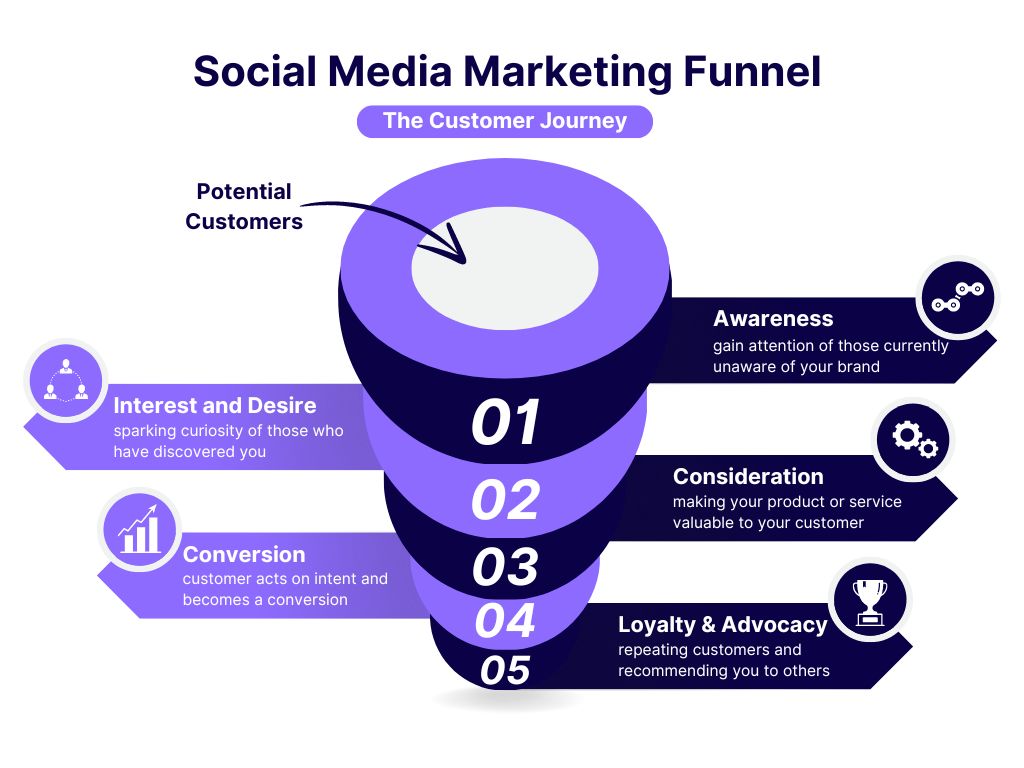
Social media marketing funnel is the path your customers take on their journey with your business, from the first point a person becomes aware of your brand, through to potential purchase and beyond.

Like other areas of marketing and digital advertising, social media follows a similar pipeline concept. Experts and industry professionals may have slightly differing views on how many stages there are and what they should be called, but there is always an overarching basic framework in which they all follow, outlining the customers route from discovery to conversion and on to continued brand loyalty.

Social media marketing funnel consists of six possible stages. In this article, we will explore each one in turn – exploring what the customer is experiencing and discuss how you can adapt your social media activity to hit your audience at these crucial moments to produce the most engagement and ultimately move them further down the funnel to conversion.

The social media marketing funnel stages for the purpose of this analysis are:

  • Awareness – seeking to gain attention of those currently unaware of your brand or business.
  • Interest and Desire – sparking curiosity of those who have discovered you, presenting your product or service as desirable.
  • Consideration and Intent – making your product or service valuable and attainable to your customer so that they intend to purchase.
  • Conversion – The customer acts on intent and becomes a conversion through purchasing your product or service.
  • Loyalty – The customer has had a good social media driven shopping experience with you and will go on to purchase again.
  • Advocacy – The customer had such a good social media driven shopping experience, potentially multiple times, they become brand ambassadors and recommend your business to others.
Social Media Marketing Funnel

Social Media Marketing Strategy

A social media strategy is a plan that outlines your social media goals, the tactics used to achieve them and metrics tracked to measure performance. Your strategy doesn’t need to be complicated. What you want is a simple and specific plan with meaningful measurables. This will help you to identify the channels and tactics that are successful, versus those that fall flat. Ultimately, your social media strategy should drive brand awareness and engagement across social media channels for your target audience/s.

Social media strategy has tangible benefits like

  • A direction for all your social media activities
  • Improve brand awareness
  • Offer social customer service and support
  • Enhance targeting across audiences
  • Direct and increase website traffic
  • Personalize content
  • Generate better quality leads
  • Create social media influencer opportunities
  • Promote your unique content that could go viral
  • Offer social commerce and shoppable posts
  • Data you can analyze and measure

Steps to create a successful Social Media Strategy

  • Set goals/objectives for business: Choose a SMART (Specific, Measurable, Achievable, Relevant & Time Bound) goal/objective and then proceed further.
  • Audience Research: Choose the right Audience. To create personalized content, you need to understand who your audience is and what they want. The best way to achieve that is to conduct market research through online surveys, interviews with your customers or by setting up a focus group. Another way to find out more about your customers and community is to do social listening. Understand buyer personas which combine your buyer profile and buyer insights to create a picture of your ideal customer. Check out the detailed article on Audience Research.
  • Research your competitors: Competitor research is a crucial part of your social marketing strategy. It helps you understand what your competitors are doing in the social space such as what platforms they use and campaigns they run.
  • Choose Social Media Platforms that suits your goal/objective of strategy.
  • Plan, Create Engaging Content & Automate: Create good engaging content, create content calendar and schedule posts.
  • Monitor KPI’s and measure results
  • Improve your strategy based on results.

What is social media optimization?

Social media optimization is the process of improving your social posts (or your whole social media strategy) to achieve better results: faster follower growth, higher levels of engagement, more clicks or conversions, etc. To increase Traffic on your website using social media marketing.

Optimizing social media for business can involve many different techniques and tactics that vary in scope and complexity, such as:

  • Basic improvements on post level, e.g. asking an engaging question in a post caption or picking a more thumb-stopping visual
  • High-level improvements, e.g. redefining your brand’s tone of voice on social media
  • Optimizing Ad Campaigns, Budget Optimization

In any case, social media optimization should be based on performance analysis, audience and competitor research and/or insights gathered through social listening.

  • Think of SMO as an opportunity for you to analyze and adjust your online presence to make it perform even better.

Benefits of social media optimization

Here’s what the right social media optimization tactics can do for your social media efforts:

  • Grow your followers at a faster rate
  • Understand your audience on a deeper level
  • Increase brand awareness on social media
  • Improve reach on social media
  • Improve the quality of your leads from social media
  • Sell more of your products and services through social channels
  • Increase your engagement rate
  • Improve your ROAS
  • Improve your Customer Acquisition Cost (CAS) & Return on Investment (ROI)

Ways to implement Social Media Optimization

  • Social Media Search Optimization
    • Optimize your social media profiles, accounts and pages.
    • Do Market Research & Keyword Research to improve search rankings.
  • Follower Growth
    • Understand your audience.
    • Create content that focusses on their pain points.
    • Use Hashtags.
    • Use Awareness Ads.
    • Add Follow buttons of Social Media Platforms on your website.
  • Engagement on Social Media
    • Create content for your audience and post daily.
    • Prepare content calendar and schedule contents.
    • Try different types of contents and analyse engagement.
    • Using Page Insights and optimize your content marketing strategy.
    • Use Traffic and Engagement Ads Campaign.
    • Follow trends and create content using trending hashtags & audios.
  • Optimizing Contents
    • Try and test various types of Content
    • Identify Your Social Media Goals
    • Use Hashtags
    • Create Valuable Content That Solves Your Followers’ Problems
    • Use Multiple Images/Short Videos
    • Include Calls-to-Action
    • Use Attention-Grabbing Headlines/Captions
    • Use User Generated Content (UGC)
  • Better Conversions
    • Be consistent with your branding.
    • Add website/landing page links in profile/pages.
    • Make your website/landing page seamless and mobile friendly
    • Create and promote using product and service-related videos.
    • While creating ads, use compelling headlines, right call to action button.
    • Use A/B or Split Testing to improve your social media posts and ads campaign performance.
    • Use User Generated Content, reviews, feedback as a proof to build trust.
    • Social Listening must be part of your routine.
  • Improving ROAS & ROI
    • Target the right Audience.
    • Use Daily Budget in ads.
    • Analyse Ads Campaign and gradually increase your budget.
    • Use A/B or Split Testing to improve your social media posts and ads campaign performance.
    • Have a clear understanding of Bid Strategies, Ad Delivery or Performance Goals and Conversions.
  • Overall Performance
    • Create a Social Media Marketing Strategy with SMART objective & goals.
    • Target the right Audience.
    • Do Market Research and understand buyer’s persona.
    • Focus on more engagement than reach.
    • Use content marketing strategy to grow.

Organic vs Paid Social Media Marketing

We can split Social Media Marketing into two :

  • Organic Social Media Marketing – focuses on building a community and deepening relationships with consumers in an effort to induce interest and customer loyalty.
  • Paid Social Media Marketing – spending money on displaying advertisements or sponsored marketing messages on popular social media platforms and targeting a specific sub-audience.

Top 10 Social Media Platforms

  • Facebook: For building brand awareness and generating leads
  • Instagram: For visually showcasing your services and building a community
  • Twitter: For thought leadership, networking, and real-time engagement
  • LinkedIn: For professional networking and showcasing expertise
  • YouTube: For creating informative video content and tutorials
  • Quora: For sharing industry-specific knowledge and building credibility
  • Google My Business: For local visibility and customer reviews
  • Pinterest: For visual discovery and inspiration
  • WhatsApp: For personalized customer communication
  • Telegram: For personalized customer communication

Unlock free access to proven marketing tactics.

USP to Storytelling: Content Marketing Strategy That Works

In the competitive world of digital marketing, a compelling landing page can make or break your campaign. At the heart of every successful copywriting strategy lies a powerful premise — the emotional concept that not only grabs attention but keeps the audience engaged until they take action. While often confused with the unique selling proposition (USP), a premise goes beyond just benefits. It’s a carefully woven narrative that connects your message with the desires and emotions of your target market. In this guide, we’ll explore how to craft an unpredictable, authentic, and persuasive premise using proven techniques to boost conversions and drive results.

Table of Contents

It’s all about the premise

As a term in formal logic, the premise is a proposition supporting a certain conclusion. Applied to copywriting, I use the word premise to mean the emotional concept that not only attracts attention, but maintains engagement throughout every element of your landing page copy and imagery.
In other words, the premise is the concept that weaves itself from headline to call to action, tying everything together into a compelling, cohesive, and persuasive narrative with one simple and inevitable conclusion — your desired action.
The premise connects you to the emotional center of your prospect’s brain, stimulates desire, maintains credibility, and results in the opening of the wallet. It’s the unification of the prospect’s worldview + the market + the benefits + the proof + a call to action into one simple, compelling message.

Start with the prospect, not the product

There’s an old saying in direct marketing circles ... start with the prospect, not the product. In other words, what does your market want? And related to that, can you reach that market and is it big enough to be worth your time?

Is the premise the same as the USP?

You probably already know about the USP, or unique selling proposition. It’s an advertising concept that dates back many decades, but if you’re not familiar with it, here’s a quick explanation.

    An advertising guy named Rosser Reeves published a book called Reality in Advertising back in 1961. It was in that book that he introduced his concept of the unique selling proposition. Reeves said a USP has three components: 1. Each advertisement must make a proposition to the prospect. Each must say, “Buy this product, and you will get this specific benefit.” 2. The proposition must be one that the competition either cannot, or does not, offer. 3. The proposition must be so strong that it can pull over new customers to your offer.
Another way to think of the USP is as a “remarkable benefit.”
In this day and age of hyper-competition, it’s difficult to offer features that no other competitor can. So now the modern practice of positioning is all about the space your messages occupy in the mind of your prospective customer and how well you match up with their worldviews. This is what finding a strong premise is all about. Often, it simply comes down to telling a different story.

So, is the premise a USP or not?

Modern positioning is all about story, and every story has a premise. So, in this case, your USP is also a premise. But from a copywriting/promotional campaign standpoint, a premise is a specific story or concept that supports and flows from the top-line positioning. Here’s a famous example.

    Nike has one of the most powerful positioning statements on the planet, expressed in three little words — just do it. Beyond selling shoes, this is life philosophy boiled down to its essence, and that’s why it’s so powerful.
In essence, every promotional premise is an aspect of positioning, but it’s not the whole thing. It’s a new chapter in the story that a particular company, product, or service is telling the marketplace, and it further shapes and defines the role in the marketplace and in the minds of prospects. When you get right down to the fact that as a copywriter, you’re a storyteller, you know that story is all about how you tell it. It’s not just an idea or a benefit, it’s the way you communicate that idea or benefit in each and every message.

How to come up with a killer premise?

Premise Step One: Create the Concept

Great ideas are unique. There’s no formula for innovative ideas, and anyone who tries to tell you otherwise is selling the slickest of snake oil. That said, a great premise always has certain elements in common. It took me many years to understand that, beyond all the tactics, it’s the premise of the message that matters first and foremost. Let’s understand the essential elements:

  1. Be unpredictable - The first thing you absolutely must have is attention. Without initial attention, nothing else you’ve done matters. And nothing kills attention faster than if your prospective reader, listener, or viewer thinks they already know where you’re going. Beyond curiosity, a great premise delivers an unpredictable and unexpected element that makes it irresistible.
  2. Be simple – Be clear and simple.
  3. Be real/authentic
  4. Be Credible

Premise Step Two: Execute with the 5P Approach

You’ve got to tell the story in a way that works, and with a structure that succeeds. A popular copywriting structure is AIDA (attention, interest, desire, action), which dates back to the early days of mass media advertising. AIDA is a useful framework, but it leaves too little room for a true understanding of what each element is intended to include.

  1. Premise - When it comes to getting people to take action now, as opposed to “thinking about it” (and often never returning), it all begins with the premise. Your copy needs an exceptional premise that allows you to make a resulting bold promise that attracts attention and compels your ideal prospect to read, watch, or listen to the rest of your message.
  2. Promise - We need to make a bold promise. Here, it may be tempting to think of the promise as being the same as your offer, but in reality, your offer is simply a component of the larger promise.
  3. Picture - You’re fleshing out the premise, promise, and setting up the benefits of taking action now by using vibrant language that sticks in the mind. The picture phase is all about using images, storytelling, and tangible language as a way to hold the reader’s emotional interest while you nudge them down the path to acceptance. It also keeps you focused on communicating the benefits associated with the features or facts that you need to get across.
  4. Proof - You’ve communicated the foundational information you want readers to accept in an emotional and brain-friendly manner. Now you’ve got to back it up with supporting proof. Statistics, studies, graphs, charts, third-party facts, testimonials, a demonstration that the features of your product deliver the benefits you’ve promised—these are all part of the Proof section of your piece. Now’s the time to play it straight and appeal to the reader’s logical mind to support the emotional triggers you pulled with the promise and picture.
  5. Push - The push phase is more than just a call to action. It’s about communicating an outstanding offer in a clear, credible, and compelling fashion, and then asking for action. It’s the grand finale where the premise and the purchase make as much sense to the reader as they do to you.

7A Framework for Effective Content Marketing Strategy

Agile – flexible, adaptive, basically constant iterative process based on continued research and audience feedback.

  1. Research & create – smart guess based on initial research
  2. Release
  3. Optimize
  4. Repeat
Authentic – find authentic story a market segment wants to hear.
Attention
  1. Test Headlines / Hooks
  2. Follow Brand Voice
  3. Refine Editorial Voice
  4. Focus on Conversion
  5. Constantly refine your approach.
Audience – feedbacks / open-ended questions to identify frustration & desire.
Authority – It’s not enough just to have an audience -- it’s how that audience feels about you. Are you the expert, the likeable expert? That again, applies to your own marketing, which is why it helps to be an industry expert or a local expert, because that creates that authority as opposed to a generalist.
Action – content that drives audience to person desired action, leads/sales often building an audience.
Acceleration – feedbacks / open-ended questions to identify frustration & desire.

Social Media Trends 2024

Social media is constantly evolving, and keeping up with the latest trends can be difficult. But if you want to stay ahead of the curve and make the most of your social media marketing efforts, it's important to be aware of what's coming down the pipeline. Let’s discuss some of the top social media trends for 2024, including the rise of generative AI and the increasing use of AI tools.
While the rise of AI is exciting, it's important to remember that human connection is still at the heart of social media. Don't let AI completely take over your social media presence. Use these tools to free up your time and resources, but focus on creating content that resonates with your audience on a deeper level. Respond thoughtfully to comments, answer questions in a human voice, and participate in conversations. Let your brand personality shine through, and you'll build stronger relationships with your followers. After all, in the age of automation, a genuine connection can be a powerful differentiator.

Table of Contents

The rise of Short-form Video on Social Media

Short-form video is taking the world by storm. Platforms like TikTok and Instagram Reels are already incredibly popular, and their popularity is only going to grow in 2024. If you're not already using short-form videos in your social media marketing, now is the time to start. It's a great way to reach a wider audience and engage your followers.

The importance of Authenticity

People are increasingly drawn to brands that are authentic and relatable. In 2024, it will be more important than ever to show your human side on social media. Share behind-the-scenes content, let your employees shine, and be honest and transparent with your followers.

The focus on building Social Media community

Social media is no longer just about broadcasting your message to the world. It's about building relationships with your followers. In 2024, focus on creating a strong community around your brand. Respond to comments and messages, host live Q&A sessions, and run contests and giveaways.

The rise of Influencer Marketing

Influencer marketing is a powerful tool to help you reach a wider audience and boost your brand awareness. In 2024, influencer marketing will continue to grow. But it's important to choose your influencers carefully. Make sure they align with your brand values and that their audience is a good fit for your target market.

The importance of Data and Analytics

Social media is a data-driven game. If you want to be successful, you need to track your results and make adjustments as needed. In 2024, focus on using data and analytics to improve your social media marketing efforts. Track your engagement, reach, and website traffic. Then use this data to inform your content strategy and targeting.

The Rise of Generative AI

Generative AI is a type of artificial intelligence that can be used to create new content, such as text, images, and videos. In 2024, we can expect to see even more generative AI used on social media. Brands can use generative AI to create personalized content for their followers or to create new ad formats.

The Increasing Use of AI Tools

There are a growing number of AI tools available that can help you with your social media marketing. These tools can help you with tasks such as scheduling posts, tracking analytics, and creating content. In 2024, we can expect to see even more businesses using AI tools to improve their social media marketing.

The Evolving Social Commerce Landscape

Social commerce has been steadily growing, and in 2024, we can expect it to become even more integrated into the social media experience. Platforms will continue to develop features that make it easier for users to discover and purchase products directly within the app. This presents a huge opportunity for brands to leverage social media not just for brand awareness, but also for direct sales. Be sure to explore features like shoppable posts, live shopping streams, and influencer partnerships to turn your social media followers into paying customers.

Performance Marketing: Giving Wings to Brands

In the constantly changing world of marketing, two critical elements, brand marketing, and performance marketing, work parallel to propel the success of a business. These two elements serve distinct yet interdependent purposes, and understanding their amalgamation is key to mastering effective marketing. In this article, we’ll explore the essence of brand and performance marketing, emphasizing the crucial role of the brand at the top of the marketing funnel, with a particular focus on addressing the research-driven consumer journey.

Table of Contents

Building the Brand’s Identity

Brand marketing serves as the foundation of a company’s identity. It incorporates a wide range of strategies and activities dedicated to shaping and maintaining a company’s reputation and defining its product characteristics. At its core, brand marketing is about shaping perceptions and fostering brand empathy. While it may not directly lead to immediate customer conversions, brand marketing lays the essential foundation upon which successful performance marketing initiatives thrive. A strong brand foundation has several significant benefits, the foremost being the establishment of trust. Trust is the key player in any successful business-customer relationship. Consumers are more likely to feel confident in their interactions when they encounter a brand with a solid reputation. This is a crucial aspect of the buying process that often gets overlooked because it’s not very predictable and its impact is difficult to measure. However, marketers who focus on establishing these meaningful points of connection will see the fruits of their efforts, especially considering how the customer journey has shifted over time.

Understanding the Shift in Consumer Behaviour

Today’s consumers have evolved from passive recipients of marketing messages into proactive researchers who actively seek information to make informed decisions. Empowered by easy access to information across various channels, they conduct their research online through search engines like Google and third-party publications to address their needs and pain points. This transformation in consumer behavior highlights the evolving nature of the consumer journey. It has become more complex due to the expansion of marketing channels and platforms. Brands are competing for attention and influence on more channels & and platforms than ever before. And as a result, consumers are encountering more touchpoints during their decision-making process. They no longer follow a linear path to conversion but explore research, and deliberate across channels, seeking answers and solutions. In response to this dynamic landscape, brands face the challenge of establishing an authentic connection with consumers and meeting them where they are–which means delivering the most relevant message where they are already conducting their research. Consumers have finite time and attention. It’s far more efficient to get in front of consumers where they already spend their time and attention rather than trying to shift their behavior. For this reason, brands must aspire to be audience-led, reaching consumers on their preferred platforms. This shift in consumer expectations necessitates a corresponding shift in marketing strategies.

Importance of TOFU

This audience-led approach requires brands to address consumer questions and pain points early in their research process. Marketers must create content tailored to these inquiries and concerns to reinforce their brand as a credible and valuable resource. By providing informative blog posts, articles, videos, and other content formats, brands not only capture the attention of potential customers but also guide them toward considering the brand’s products or services as viable solutions. Brands that fail to create content to address these early-stage inquiries risk missing out on valuable opportunities to connect with and influence potential customers.

Brand Identity improves Content Consumption

The key to unlocking a strong TOFU content strategy is a strong brand presence. Companies that have a powerful brand identity, characterized by clear values, a compelling mission, and a consistent tone of voice, are better positioned to create content that resonates with potential customers. When consumers encounter content that aligns seamlessly with the brand’s established identity, they experience a sense of reliability and authenticity. This builds the awareness and trust we discussed, and will significantly enhance the reach of top-funnel content. Moreover, brands that have a clear understanding of who they are, are more effective at creating valuable content. They leverage owned assets and customer insights to inform content plans and strategies, ensuring that their messaging aligns with their identity and resonates with their target audience. By consistently reflecting their core identity in their content, these brands not only capture the attention of potential customers but also guide them toward considering the brand’s products or services. Brands that fail to maintain a strong and consistent identity risk missing out on valuable opportunities to connect with potential customers during their research-driven journey.

Performance Marketing: Giving Wings to Brands

Performance marketing is a digital advertising strategy in which brands pay marketing companies or advertising platforms depending on the campaign results. Now that we understand why brand marketing is a pivotal component of content strategy, we can better understand how it converges with performance marketing. Down-funnel marketing programs are all about achieving specific, measurable objectives with tangible outcomes. It complements brand marketing by capitalizing on a robust brand presence. When customers encounter a brand they trust during the consideration phase, it significantly influences their purchase decisions. Performance marketing employs tactics like social media marketing, email marketing, paid search advertising, affiliate marketing, and sponsored ads to generate leads. While it may appear to be the more cost-effective strategy, it heavily relies on a solid brand foundation to position potential customers for conversion. For B2B companies with extended buying cycles, the connection between brand and performance marketing becomes even more critical. While creating performance marketing campaigns for down-funnel marketing, it is important to focus on the following:

  • Targeting your ads to the right people.
  • Ad messaging should be clear, concise, and persuasive.
  • Landing pages should be relevant to your ad campaigns and should be designed to convert visitors into customers.
  • Testing and optimizing your performance marketing campaigns regularly.
  • Use customer data to personalize your campaigns. The more personalized your campaigns are, the more likely they are to resonate with your target audience and drive conversions.
  • Create a seamless customer experience. Make sure that your landing pages and website are consistent with your ad campaigns, and that it is easy for customers to complete a purchase.
  • Track and measure your results. It is important to track and measure the results of your performance marketing campaigns so that you can identify what is working well and what needs to be improved.
Performance marketing can be a very effective way to drive sales and grow your business. By targeting the right people with the right message at the right time, you can convert leads into customers and achieve your marketing goals.

The Key Benefit of Down-Funnel Marketing with Established Brand Awareness

Building on a strong foundation of brand marketing, performance marketing can achieve remarkable results when a brand has already established awareness and trust within its target audience. As discussed, performance marketing operates as an extension of the brand, capitalizing on the recognition gained through brand-building efforts, including their upstream content marketing strategy. When consumers encounter bottom-funnel marketing initiatives from a trusted brand, they are more inclined to take action, such as making a purchase, signing up for a demo, or downloading a white paper. This pre-established credibility significantly enhances the effectiveness of performance marketing campaigns. Successful performance marketing efforts further strengthen and extend the value of the brand, creating a flywheel effect where the value compounds. Marketing leaders must understand how these two strategies work hand in hand to navigate the complexities of the modern marketing landscape and achieve sustained business growth. Brand marketing and performance marketing are not isolated strategies but rather two sides of the same coin, and optimizing this dynamic synergy is key to resonating with consumers and driving success.

About

We are passionate about helping businesses and individuals achieve success in the ever-evolving world of digital marketing. We believe that anyone can master digital marketing skills with the right knowledge and guidance.

Story

From Inspiration to Education​

The journey began with a shared frustration. We witnessed countless businesses struggling to navigate the ever-changing digital landscape, missing out on the incredible opportunities it presents. We saw individuals brimming with potential, eager to dive into digital marketing, yet lacking the clear roadmap to success. This ignited a spark within us, a mission to bridge this gap and empower everyone to harness the power of digital marketing.

Approach

Building Confidence Through Knowledge

Learn With DV isn't just another educational platform; it's a supportive community where you'll embark on a transformative learning experience. We believe in the power of clear, concise, and actionable knowledge. The online resources are meticulously crafted by seasoned digital marketing professionals, ensuring you gain practical skills and strategies that can be implemented immediately. We understand that learning goes beyond passive consumption of information. We foster a dynamic learning environment that caters to diverse learning styles.

Mission

To provide accessible, high-quality digital marketing education that is:

  • Actionable: We focus on practical strategies and tactics you can implement immediately.
  • Expert-Led: Our learning resources are developed by industry professionals with proven experience.
  • Results-Oriented: We help you achieve measurable results through data-driven marketing strategies.

Passion

Your success is our ultimate reward. We are committed to providing you with the resources and support necessary to achieve your digital marketing goals. Whether you aspire to take your business to new heights, launch a thriving freelance career, or simply gain valuable skills to enhance your professional profile, we're here to guide you every step of the way.

Join us on this exciting journey, and unlock the power of digital marketing to achieve your dreams!